
Chiaroscuro in the Renaissance: Techniques, Masters, and Lasting Influence
Light and shadow are among the oldest tools in visual art, but during the Renaissance they became something more than a way of describing the physical world. Artists learned to use the transition from illumination to darkness to construct volume, organize a composition, direct the viewer’s attention, and create a sense of atmosphere and emotion.
This approach became known as chiaroscuro, from the Italian words chiaro (light) and scuro (dark).
At its most effective, chiaroscuro does not simply show where the light falls. It makes the viewer aware of everything that remains outside it.
What Is Chiaroscuro?
Chiaroscuro refers broadly to the deliberate use of contrasting light and dark tones to give objects and figures a sense of volume and spatial presence.
A painted face, for example, does not need a detailed outline to appear three-dimensional. A transition from a bright forehead to a middle tone around the cheek and finally to a darker side of the face can suggest the underlying structure of the head. The viewer’s eye completes the form.
This was particularly important during the Renaissance, when artists became increasingly interested in observing the natural world and representing the human body, architecture, and space with greater visual coherence.
The technique was not simply about making paintings look more realistic. Light could establish a hierarchy within an image. It could tell the viewer where to look first, separate foreground from background, reveal one figure while concealing another, or transform an ordinary gesture into a dramatic moment.
In this sense, chiaroscuro became both a technical method and a visual language.
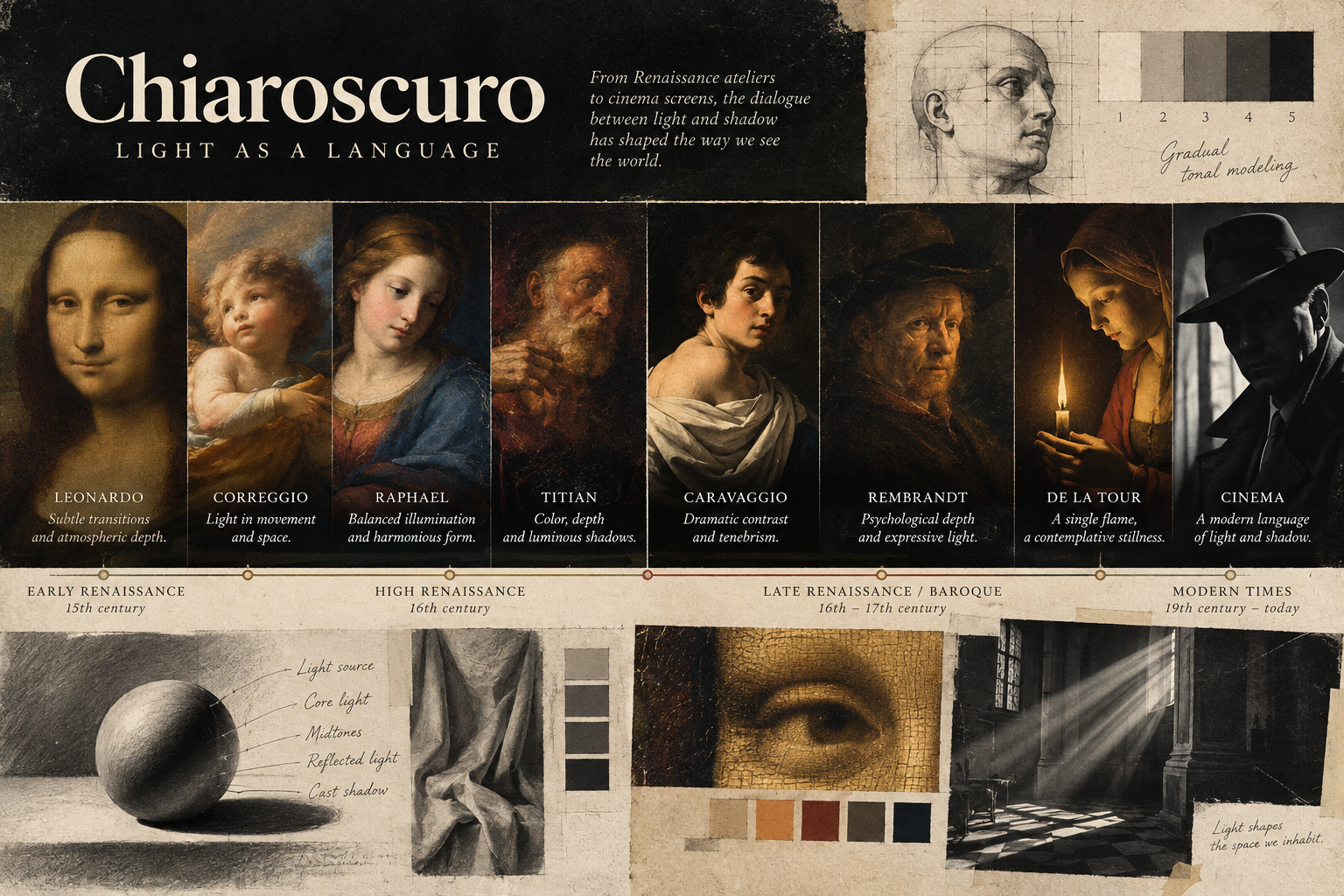
How Renaissance Artists Created Chiaroscuro
Renaissance painters developed several techniques for controlling the relationship between light and shadow. These methods were often combined rather than used independently.
Gradual Tonal Modeling
One of the fundamental principles was the gradual movement from light to dark.
Instead of defining a figure with hard outlines, painters could build its volume through a sequence of illuminated areas, middle tones, and shadows. This was especially effective when depicting faces, hands, muscles, and folds of fabric.
The transition could be so subtle that the boundary between one tone and another almost disappeared.
This helped create the impression that the painted surface was not flat but occupied a believable physical space.
Directional Lighting
The apparent direction of the light became another important compositional tool.
A light source positioned to one side could illuminate one part of a face while leaving the other in shadow. Light coming from above could emphasize the forehead, nose, shoulders, or hands. A more frontal light produced a different effect, reducing shadows and creating a more evenly illuminated scene.
The choice was rarely neutral.
By controlling the direction of illumination, an artist could establish the visual structure of the entire painting.
Strong Light-Dark Contrast
The relationship between a brightly illuminated subject and a darker surrounding area could immediately attract attention.
A figure emerging from shadow becomes visually important even before the viewer understands what is happening in the scene. This made chiaroscuro particularly useful for religious and historical paintings, where artists needed to establish a clear hierarchy among numerous figures and details.
Darkness could also simplify a composition by allowing secondary elements to disappear.
Layered Glazes
Many Renaissance painters also relied on thin, transparent layers of paint known as glazes.
Applied over previously painted layers, glazes could modify color and deepen shadows while allowing some of the underlying tones to remain visible. This created subtle variations that were difficult to achieve with a single opaque layer.
The result could be particularly effective in darker areas, where color does not simply become black but retains traces of warm and cool tones.
This relationship between darkness and color is one reason Renaissance shadows can feel surprisingly luminous.
Leonardo da Vinci and the Softening of Edges
Few artists are more closely associated with the subtle modeling of light than Leonardo da Vinci.
Leonardo developed the technique known as sfumato, a term derived from the Italian fumo, or smoke. Rather than producing a clear boundary between illuminated and shadowed areas, sfumato allows forms to dissolve gradually into one another.
The effect is visible in the faces of figures such as the Mona Lisa. The edges of the mouth, eyes, cheeks, and surrounding landscape are not always sharply defined. Instead, they seem to emerge from an atmospheric transition between tones.
Sfumato and chiaroscuro are related but not identical.
Chiaroscuro concerns the broader relationship between light and dark and their role in modeling form and organizing a composition. Sfumato refers more specifically to the soft, almost imperceptible transitions between tones.
Leonardo’s contribution was to demonstrate how much information could be communicated without a hard edge.
Sometimes, the less clearly a boundary is defined, the more alive the form appears.
Raphael, Correggio, and Titian
Leonardo was not alone in exploring the expressive possibilities of light.
Raphael used controlled illumination to clarify figures and reinforce the structure of his compositions. His paintings often balance areas of light and shadow without allowing darkness to overwhelm the overall harmony of the scene.
Correggio pushed the relationship between illumination and movement further. His dramatic use of light, especially in religious compositions, helped create an almost theatrical sense of space. Figures appear to emerge through clouds, architecture, and atmospheric transitions rather than simply occupying a flat painted background.
Titian, meanwhile, approached light through color as much as through tonal contrast. His rich surfaces and layered pigments demonstrated that illumination could be suggested not only by making an area lighter, but also by changing its color, temperature, and saturation.
Together, these approaches reveal that Renaissance chiaroscuro was never a single formula. Different artists used light according to their individual interests in anatomy, atmosphere, color, narrative, and emotion.
From Chiaroscuro to Tenebrism
The dramatic possibilities of chiaroscuro became even more pronounced during the late sixteenth and early seventeenth centuries.
One of the most important developments was tenebrism, a more extreme approach in which large portions of the composition are dominated by darkness while figures or details are isolated by intense illumination.
This is where Caravaggio becomes particularly important.
Although he belongs to the transition from the late Renaissance into the Baroque period rather than to the Renaissance itself, Caravaggio took earlier experiments with light and pushed them toward a new kind of visual drama.
In The Calling of Saint Matthew, for example, a strong diagonal beam of light enters the dark interior and draws attention to the figures around the table. The light does not merely describe the room. It becomes part of the narrative.
A biblical event is transformed into something immediate and physical: people sit, gesture, look, hesitate, and suddenly become aware of something happening outside the ordinary rhythm of the room.
Light becomes an event.
Rembrandt and the Human Face
The language of chiaroscuro continued to evolve in the work of Rembrandt van Rijn.
Rembrandt frequently allowed parts of his subjects to disappear into darkness while concentrating illumination on faces, hands, or small areas of the body.
The effect is not simply dramatic. It can create intimacy.
A face emerging from darkness appears to exist independently of its surroundings. Details that would normally be secondary can become the emotional center of the image.
Rembrandt also demonstrated how light could change our perception of age, expression, texture, and character. His portraits often feel less like demonstrations of physical appearance and more like encounters with a person.
Georges de La Tour and the Light of a Single Flame
Another fascinating development came from Georges de La Tour, whose paintings often revolve around a single candle.
Unlike the explosive lighting associated with Caravaggio, La Tour’s compositions can feel remarkably quiet.
The candle illuminates faces, hands, and fabrics while leaving the surrounding space almost completely dark. Because the light source is visible, the viewer understands the physical reason for the illumination.
But the candle also establishes a particular kind of stillness.
The darkness is not merely an absence of information. It becomes part of the composition itself.
Chiaroscuro and the Baroque Imagination
During the Baroque period, the contrast between light and shadow became increasingly theatrical.
Artists could use illumination to create movement, emphasize gestures, and make figures appear to emerge from an undefined space. The viewer was no longer simply looking at a scene; the composition could feel as if the scene were unfolding directly in front of them.
This relationship between light and theatricality would become one of the defining characteristics of Baroque visual culture.
Yet the underlying principle remained remarkably simple:
Show the viewer what matters. Let everything else recede.
From Painting to Photography
The influence of chiaroscuro did not end with oil painting.
When photography emerged in the nineteenth century, photographers inherited many of the same visual problems that painters had explored for centuries: how to model a face, separate a subject from its background, establish depth, and direct attention.
Photography introduced a crucial difference.
The camera does not merely represent the behavior of light; it records it.
A photographer can therefore work directly with natural illumination, studio lighting, exposure, reflections, shadows, and the physical environment to create an image in which light becomes the primary compositional structure.
Portrait photography, still life, architectural photography, and street photography have all used this principle in different ways.
The vocabulary changed, but the fundamental question remained familiar to Renaissance painters:
What should the light reveal, and what should it leave hidden?
Chiaroscuro in Cinema
Few modern visual forms have embraced chiaroscuro as deeply as cinema.
Early filmmakers quickly discovered that light could establish atmosphere, separate characters from their surroundings, and create psychological tension.
The visual language became particularly recognizable in film noir, where low-key lighting, deep shadows, silhouettes, and narrow areas of illumination became central elements of the style.
A face partially hidden in darkness can communicate uncertainty without a single line of dialogue. A corridor illuminated only at one end can create a sense of distance and anticipation. A figure appearing against a dark background immediately becomes the visual focus.
These are essentially cinematic versions of problems Renaissance painters had been solving centuries earlier.
Goya, Romanticism, and the Expressive Shadow
The nineteenth century brought another transformation.
Artists such as Francisco Goya used dramatic contrasts between light and darkness to explore subjects that could be disturbing, mysterious, or psychologically unsettling.
In works such as The Third of May 1808, illumination becomes a moral and emotional device. The brightly illuminated figures are set against a surrounding darkness that intensifies the violence and tension of the scene.
Here, light is no longer primarily concerned with modeling physical form.
It can represent vulnerability, fear, exposure, or confrontation.
This expanded the possibilities of chiaroscuro far beyond its Renaissance origins.
Why Chiaroscuro Still Matters
What makes chiaroscuro so persistent is that it corresponds to something fundamental about how we see.
Our attention is selective.
We do not experience every part of a visual environment with equal intensity. Light attracts us, contrast separates forms, and darkness conceals information. Artists have been able to use those basic characteristics of perception to construct images that feel immediate and intentional.
Chiaroscuro also introduces a productive tension between what is visible and what is not.
A completely illuminated image can tell us everything.
An image containing darkness asks us to participate.
That is perhaps why the technique continues to appear in contemporary photography, cinema, graphic design, portraiture, advertising, and visual art. The tools have changed—from brushes and glazes to cameras, lenses, sensors, and digital editing—but the visual principle remains recognizable.
Light reveals.
Shadow edits.
And the space between them is where much of the image begins to happen.
The Enduring Language of Light and Shadow
From Leonardo’s almost imperceptible transitions to Caravaggio’s theatrical beams, from Rembrandt’s faces emerging from darkness to the candlelit stillness of Georges de La Tour, chiaroscuro has continually evolved without losing its essential character.
It began as a way of making painted forms appear solid and convincing. It became a method of organizing compositions, directing attention, creating atmosphere, and suggesting emotional depth. Later painters, photographers, and filmmakers transformed those principles for entirely different media.
The Renaissance discovery was not simply that shadows make light more visible.
It was that darkness can be an active part of an image.
Sometimes the most important thing in a picture is not what the light shows us, but what it allows us to imagine beyond it.